
Search Georgia Inmate Records
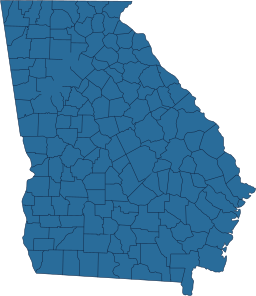
Georgia operates various correctional facilities. These include about 25 state prison facilities, 13 transitional centers, 7 probate detention centers, 7 substance abuse centers, and 25 county correctional institutions. These facilities are all under the supervision and management of the Georgia Department of Corrections (GDC). The state also has at least 142 county jails spread across 159 counties. The average rate of incarceration in Georgia is 435 persons per 100,000 total population.
At least seven out of the several state-run correctional facilities in Georgia serve adult female inmates, particularly those convicted of felons. In addition, there are five federal correctional facilities within the state. Furthermore, the Georgia Department of Corrections (GDC) has a running contract with two private prisons that can house 5,376 state offenders.


Georgia Department of Corrections Inmate Search
The Georgia Department of Corrections Inmate search system is named the Find an Offender tool. This tool is offered for the convenience and safety of the public, and the GDC has consistently ensured that the information obtained from it is true and complete. The tool allows members of the public to find inmates housed in state-run correctional facilities by name, ID, description, or case number.
While the GDC tries its best to ensure the accuracy of information published on its offenders database, it does not guarantee the completeness of information obtained from the database. Hence, the department encourages everyone to verify any information they obtain through the Find an Offender service by mailing personal written correspondence to the GDC at:
Georgia Department of Corrections
Inmate Records and Information
P.O. Box 1529
Forsyth, GA 31029
Generally, the search results obtained from any Georgia Department of Corrections inmate search will include the offender's name, their major offense, and the current correctional institution/facility of incarceration at a glance. When a user queries further by clicking the "view offender info" tab, more comprehensive details of an inmate is displayed. Such details typically include the inmate's mugshot, full name, date of birth, aliases, incarceration details, descriptors, case number, current sentences, and other important information.

Find Inmate by Name
To find an inmate by name using the GDC's Find an Offender service, enter the inmate's last name and first name in the appropriate fields of the Search by Name or Description service category and execute the search. If the complete names are unknown, enter parts of the names that are known. To streamline the search, provide the inmate's gender, race, age range, and the facility in which they are incarcerated before submitting the query.

Find Inmate by Number
An inmate incarcerated in any of Georgia's correctional facilities may be searched by one of two numeric identifiers; their case number or GDC ID number. A case number is assigned to the offense committed by each inmate in a prison. Each number is preceded by letters such as BC, EF, and PD, and an inmate may have multiple case numbers. On the other hand, the GDC ID number, also known as a UNO, is a unique numeric identifier assigned to each inmate.
To conduct an inmate search by number in Georgia using the GDC's Find an Offender Service, click the "Search by ID or Case Number" tab to expand the display. Afterward, select which numeric identifier you intend to use as the search criteria and enter the number in the appropriate field before submitting the form.
Find Inmate by Jail Type
The Find an Offender service of the Georgia Department of Corrections allows interested persons to find inmates by jail type under the "Search by Name or Description service category." To look up an inmate by jail type, select the name of the correctional facility in which the person is incarcerated from the "Most Recent Institution" drop-down menu and submit the form. Typically, the search result will include records of all offenders incarcerated in that facility.
How Many Inmates Are Currently Incarcerated in Georgia?
Georgia has an estimated incarcerated population of ~105,000 people across state prisons, county jails, federal facilities, private prisons, juvenile facilities, and other detention or pre-trial categories.
Counts vary by reporting date and agency, so the figures below are approximate statewide estimates.
| Facility Type | Population | % of Total | Avg. Daily Cost | Capacity Utilization |
|---|---|---|---|---|
| State Prisons | ~50,500 | 48.1% | ~$72 | ~98% |
| County Jails | ~35,000 | 33.3% | ~$95 | ~83% |
| Federal Facilities | ~5,800 | 5.5% | ~$120 | ~92% |
| Private Prisons | ~4,900 | 4.7% | ~$60 | ~95% |
| Juvenile Facilities | ~900 | 0.9% | ~$240 | ~60% |
| Other / Pre-Trial | ~7,900 | 7.5% | ~$85 | ~88% |
| Total | ~105,000 | 100.0% | ~$84 weighted | ~91% |
State Correctional Facilities in Georgia
The Georgia Department of Corrections operates roughly 50+ major state prisons, transitional centers, detention centers, and specialty facilities.
The system includes general population prisons, women’s institutions, medical and aged-care units, work-release centers, and community corrections facilities.
| Facility Name | Type | Location | Capacity | Population | Security Level |
|---|---|---|---|---|---|
| Georgia Diagnostic & Classification Prison | Specialty Facility | Jackson | ~2,500 | ~2,300 | Close / Diagnostic |
| Coastal State Prison | State Prison | Garden City | ~1,836 | ~1,650 | Medium |
| Phillips State Prison | State Prison | Buford | ~918 | ~850 | Close |
| Lee Arrendale State Prison | Women’s Facility | Alto | ~1,476 | ~1,300 | Close / Medium |
| Metro Reentry Facility | Women’s Facility | Atlanta | ~355 | ~320 | Minimum / Reentry |
| Augusta State Medical Prison | Medical / Aged Facility | Grovetown | ~1,326 | ~1,200 | Medium / Medical |
| Atlanta Transitional Center | Work Release Center | Atlanta | ~257 | ~230 | Minimum / Community |
| Colwell Probation Detention Center | Community Corrections Facility | Blairsville | ~470 | ~400 | Minimum / Detention |
Inmate Demographics & Population Trends in Georgia
Georgia’s incarcerated population is predominantly male and includes a large share of people serving sentences for violent offenses, with age and sentencing patterns broadly similar to other large Southern prison systems.
Recent trends show continued demand for reentry programming, substance-use treatment, and supervision resources for people returning to communities.
| Demographic Category | Breakdown | Notes |
|---|---|---|
| Gender | Male ~91%; Female ~9% | Men make up the vast majority of Georgia’s prison population, while women are housed primarily in designated women’s facilities and reentry units. |
| Age Groups | 18–24: ~10%; 25–34: ~30%; 35–44: ~28%; 45–54: ~18%; 55+: ~14% | The population is aging gradually, increasing demand for medical and geriatric care. |
| Race / Ethnicity | Black ~58%; White ~35%; Hispanic / Latino ~5%; Other / Unknown ~2% | Racial disparities remain above overall state population shares, consistent with broader national incarceration trends. |
| Top Offense Types | Violent ~57%; Property ~16%; Drug ~13%; Public Order / Other ~14% | Violent offenses account for the largest share of sentenced prison admissions and longer-term custody. |
| Avg. Sentence Length | ~9 years imposed; time served varies by offense and parole eligibility | Serious violent and repeat offenses typically carry longer sentences and more restrictive release rules. |
| Recidivism Rate | ~27%–30% within 3 years | Reconviction or return-to-custody measures vary by agency definition and release cohort. |
Parole, Release & Reentry Resources in Georgia
Georgia release options include parole consideration, supervised release, transitional programming, and limited sentence-credit opportunities for eligible individuals.
Reentry support is coordinated through state agencies, community providers, housing programs, workforce services, and victim notification systems.
| Program / Resource | Description | Who It Serves | Contact / Access |
|---|---|---|---|
| State Parole Board | The Georgia State Board of Pardons and Paroles reviews eligible cases for parole, clemency, and related release decisions. | Eligible state prisoners and families seeking parole status information. | Georgia State Board of Pardons and Paroles website or case status tools. |
| Good Time / Sentence Reduction | Georgia uses parole eligibility rules and may apply performance-based credits or program incentives for eligible individuals; exclusions apply. | Eligible incarcerated people meeting conduct, program, and statutory requirements. | Georgia Department of Corrections counselor or facility records office. |
| Parole Supervision | Community supervision includes reporting, employment requirements, treatment referrals, and compliance monitoring. | People released to parole or other post-release supervision. | Assigned parole officer or local parole district office. |
| Reentry Housing | Transitional centers and approved community providers may offer structured housing, work-release placement, or referral support. | People nearing release or recently released who need stable housing. | GDC Reentry Services, transitional centers, and local nonprofit providers. |
| Employment Assistance | Programs support job readiness, vocational training, work-release, résumé preparation, and employer connections. | Incarcerated people nearing release and returning citizens seeking work. | GDC Reentry Services, Georgia Department of Labor, WorkSource Georgia. |
| Benefits Restoration | Assistance may include identification documents, SNAP, Medicaid screening, Social Security, veterans benefits, and Georgia Gateway applications. | Returning citizens and families preparing for release. | Georgia Gateway, DFCS, SSA, DDS, VA, and facility reentry staff. |
| Victim Notification Program | Georgia VINE provides custody status and notification updates for registered victims and concerned parties. | Victims, survivors, families, and the public seeking custody notifications. | Georgia VINE online portal or toll-free VINE phone service. |
What Information is Contained in a Georgia Inmate Record?
A typical Georgia inmate record obtained from a search conducted on the GDC's Find an Offender service includes the following:
- The Inmate's Name - This is the inmate's full name, including their first, middle, and last name
- GDC ID Number - This is a unique identifying number assigned to each inmate, usually a 10-digit number
- Case Number - This is the number assigned to each offense committed by an inmate
- Physical Description - This includes information such as the inmate's year of birth, gender, race, weight, eye color, height, and hair color. If any, an inmate's record will also contain information on their marks, scars, and tattoos
- Incarceration Details - This specifies the inmate's major offense, maximum possible release date, and the most recent correctional facility in which they are incarcerated
- Important Release Information - This describes the actual release date and current status (active or inactive) of an inmate
- Known Aliases - Other names by which the inmate is called or known
- Offense - The type of offense committed by the inmate
- Conviction County - The county in which the inmate was convicted
- Crime Commit Date - The date the crime that led to the inmate's incarceration was committed
- Sentence Length - The length of the awarded sentence by number. It may be several days, months, years, or life imprisonment
- Incarceration History - The history of the inmate's past incarcerations. This typically shows the begin and end dates for each incarceration period
Georgia Inmate Records by Counties
The Georgia Department of Corrections (GDC) maintains records of inmates incarcerated in county jails on the Find an Offender service. To obtain such records from a particular county jail, enter the inmate's name, select the name of the county jail from the drop-down menu under the "Search by Name or Description service category" of the GDC's Find an Offender service, and submit the query.
Most counties in Georgia, through their sheriff's offices, also have online databases of inmates incarcerated in their county jails. Typically, an inmate's name and a few other information may be required to look up records from such databases. For instance, the Clayton County Sheriff's Office manages an Inmate Search System that enables anyone to find information about inmates incarcerated in their county jail.
- Appling County
- Atkinson County
- Bacon County
- Baker County
- Baldwin County
- Banks County
- Barrow County
- Bartow County
- Ben Hill County
- Berrien County
- Bibb County
- Bleckley County
- Brantley County
- Brooks County
- Bryan County
- Bulloch County
- Burke County
- Butts County
- Calhoun County
- Camden County
- Candler County
- Carroll County
- Catoosa County
- Charlton County
- Chatham County
- Chattahoochee County
- Chattooga County
- Cherokee County
- Clarke County
- Clay County
- Clayton County
- Clinch County
- Cobb County
- Coffee County
- Colquitt County
- Columbia County
- Cook County
- Coweta County
- Crawford County
- Crisp County
- Dade County
- Dawson County
- Decatur County
- Dekalb County
- Dodge County
- Dooly County
- Dougherty County
- Douglas County
- Early County
- Echols County
- Effingham County
- Elbert County
- Emanuel County
- Evans County
- Fannin County
- Fayette County
- Floyd County
- Forsyth County
- Franklin County
- Fulton County
- Gilmer County
- Glascock County
- Glynn County
- Gordon County
- Grady County
- Greene County
- Gwinnett County
- Habersham County
- Hall County
- Hancock County
- Haralson County
- Harris County
- Hart County
- Heard County
- Henry County
- Houston County
- Irwin County
- Jackson County
- Jasper County
- Jeff Davis County
- Jefferson County
- Jenkins County
- Johnson County
- Jones County
- Lamar County
- Lanier County
- Laurens County
- Lee County
- Liberty County
- Lincoln County
- Long County
- Lowndes County
- Lumpkin County
- Macon County
- Madison County
- Marion County
- Mcduffie County
- Mcintosh County
- Meriwether County
- Miller County
- Mitchell County
- Monroe County
- Montgomery County
- Morgan County
- Murray County
- Muscogee County
- Newton County
- Oconee County
- Oglethorpe County
- Paulding County
- Peach County
- Pickens County
- Pierce County
- Pike County
- Polk County
- Pulaski County
- Putnam County
- Quitman County
- Rabun County
- Randolph County
- Richmond County
- Rockdale County
- Schley County
- Screven County
- Seminole County
- Spalding County
- Stephens County
- Stewart County
- Sumter County
- Talbot County
- Taliaferro County
- Tattnall County
- Taylor County
- Telfair County
- Terrell County
- Thomas County
- Tift County
- Toombs County
- Towns County
- Treutlen County
- Troup County
- Turner County
- Twiggs County
- Union County
- Upson County
- Walker County
- Walton County
- Ware County
- Warren County
- Washington County
- Wayne County
- Webster County
- Wheeler County
- White County
- Whitfield County
- Wilcox County
- Wilkes County
- Wilkinson County
- Worth County
Are Incarceration Records Public Information in Georgia?

Yes. In Georgia, incarceration records are generally considered public records under the state's Open Records Act. According to this Act, all public records, including inmate records, are open for personal inspection and copying unless specifically exempted by law or a state court. Although most incarceration records in Georgia are publicly available upon request, some records or information may not be publicly accessed. For example, financial information, medical reports, and other confidential information are typically redacted from an incarceration record before dissemination.
Federal Prisons in Georgia
There are at least five federal prisons in Georgia operated and funded by the federal government under the management of the Federal Bureau of Prisons (BOP). They primarily house inmates convicted of breaking federal laws within the state. On the other hand, the state prisons in Georgia are funded by the state government and managed by the state's Department of Corrections (GDC).
Generally, federal prisons, including those operating in Georgia, are organized along different security levels. This includes low security, minimum security, administrative security, medium security, and high security. Georgia also has some federal prison camps where inmates are not subject to stringent security procedures like higher security federal correctional facilities.
| Prison Name | Location | Security Level | Average Capacity |
|---|---|---|---|
| United States Penitentiary Atlanta (FCI Atlanta) | Atlanta, Georgia | Medium | 1,656 inmates |
| Federal Correctional Institution Jesup (FCI Jesup) | Jesup, Georgia | Low | 861 inmates |
| United States Penitentiary Atlanta Camp (FCI Atlanta Camp) | Atlanta, Georgia | Minimum | 123 inmates |
| Federal Correctional Institution Jesup Camp (FCI Jesup Camp) | Jesuo, Georgia | Minimum | 106 inmates |
| Federal Satellite Low Jesup (FSL Jesup) | Jesuo, Georgia | Low | 392 inmates |
Frequently Asked Questions about Inmate Records
Below are some frequently asked questions about Georgia inmate records and how the state's correctional facilities operate:
The Georgia Open Record Act makes records maintained by the state's Department of Corrections (GDC) public. To request a Department of Corrections public record in Georgia, use the Open Records Center and select the "Submit a Record Request" tab. Generally, the Open Records Center allows the public to request GDC's operational records, inmate medical records, and general inmate records. Users are required to create an account and provide contact information, as all communication from the GDC is sent to email accounts.
You may look up an inmate incarcerated in any Georgia state prison or local county jail online through the Find an Offender service offered by the state's Department of Corrections (GDC). Also, some county sheriff's offices manage online databases through which interested persons may find inmates housed in county jails.
The GDC's Find an Offender service holds records of current and past inmates incarcerated within the state's correctional system. Hence, you may find old inmate records using this service if you have certain information about the person, such as their name, GDC ID number, and the prison facility in which they were incarcerated. Typically, the database will indicate the current status of the individual as inactive and will show the actual release date.
Alternatively, you may find an old inmate record in Georgia by mailing a written request to the state's Department of Corrections at:
Georgia Department of Corrections
Inmate Records and Information
300 Patrol Road
Forsyth, GA 31029
Inquiries on inmate death records in Georgia may be sent to the Inmate Records and Information Unit of the state's Department of Corrections (GDC). Generally, any death-in-custody that occurs in correctional facilities under the jurisdiction of the State Board of Corrections must be reported to the Commissioner of Corrections.
After booking, it takes anywhere between 24 hours and a few days for an inmate's information to be published and become available in the Georgia Department of Corrections' Find an Offender system.
You can send money to any inmate incarcerated in a Georgia corrections facility using any of the following ways:
- You may create a free money order voucher , print it, and mail it to the GDC 6901 or Georgia DOC Receiver Code 6857
- You may send cash with MoneyGram. Make sure to reference the Georgia Probation Receiver Code
- You can speak with a live agent on (800) 574-5729 (toll-free) to send money to someone in jail
- You can send money online using JPay . This allows you to enter the inmate's ID